
The Stingblade HQ has a theory, and we want to explore this with you.
The innovation of a jellyfish sting removal tool came after years of personal experience. Capt Stingblade, Mark Dyer, being stung by jellyfish repeatedly over the years, wanted to find a better way to deal with the aftermath.
That led to the creation of Stingblade.

Recently, it has also raised an interesting question:
If a jellyfish stings you once, does that sting leave a lasting trail?
Could previous stings change the way your body reacts to future encounters?
Let’s dive in.
How does a jellyfish sting?
Jellyfish have specialised microscopic stinging cells called cnidocytes, found primarily on their tentacles. Inside these cells are structures called nematocysts, rapidly discharging microscopic barbs. And they can fire incredibly quickly.
When a tentacle comes into contact with skin, these microscopic stinging structures can penetrate the skin and deliver venom. The result can be an immediate burning, prickling or painful sensation.
For anyone enjoying a day at the beach, swimming, surfing or on holiday, that’s an experience you’d rather not have.
Multiple jellyfish stings can occur
Here’s where things get even more interesting.
A jellyfish tentacle isn’t equipped with just one stinger. It contains huge numbers of microscopic stinging cells. When contact occurs, some of those cells can discharge. Others may remain capable of firing if the tentacle remains in contact with the skin or if further mechanical stimulation occurs.
This is one reason why what you do immediately after a sting matters.
At Stingblade, this is why we recommend following The Protocol.
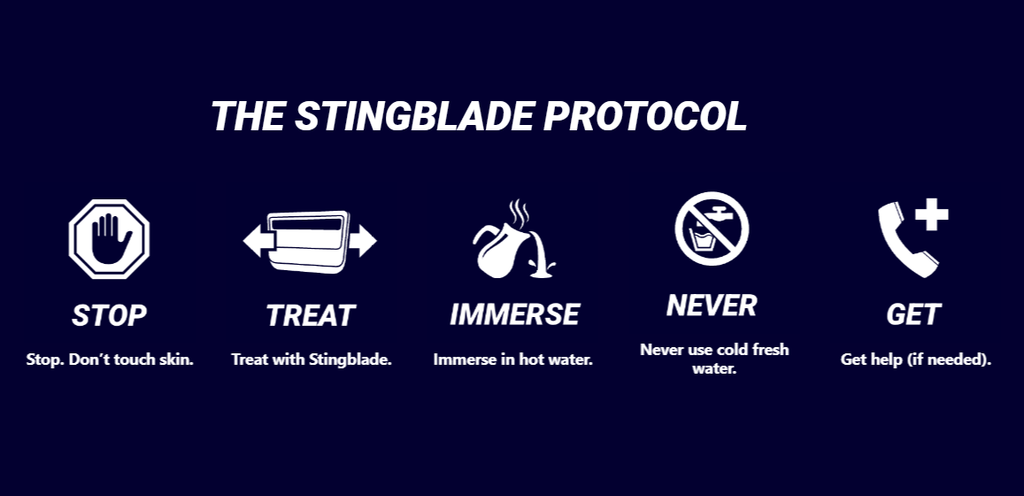
Rubbing or aggressively touching the affected area can potentially cause additional stinging cells to discharge. And that brings us back to our original question…
Do jellyfish stings leave a trail for the rest of the life?
A previous jellyfish sting doesn’t mean you’ll have a permanent physical trail on your skin. However, research suggests that repeated exposure to jellyfish stings can have consequences beyond the immediate pain and skin reaction.
A 2020 review published in Allergy and Asthma Proceedings examined jellyfish-related allergic reactions and sensitisation. The authors noted that repetitive jellyfish stings can be an important risk factor for sensitisation, meaning that repeated exposure may increase the likelihood of the body developing an immune response to jellyfish venom.
So, while your first sting may heal and disappear, your body’s history with jellyfish may not simply be forgotten.
In other words: The jellyfish sting may disappear. Your immune system may not entirely forget your response to the jellyfish sting.
What we do know is that jellyfish stings aren’t simply a case of “ouch, it’s over”. Tentacle material and microscopic stinging structures can remain on the skin after contact, and repeated exposure can be relevant to sensitisation.
That’s why Stingblade was designed around one simple idea: Remove the problem from the skin.
Rather than simply washing or rubbing the area, Stingblade is created as a jellyfish sting removal tool to help remove microscopic stinging structures from the skin without unnecessarily activating them.
Got a jellyfish question you’d like the Stingblade Sting Tank to investigate?
Send it our way. We look forward to exploring more such questions like this. Follow us for similar topics.
