
Stingblade in conversation with Tone Product Design
Jellyfish stings are a common but often misunderstood marine hazard, with advice ranging from medically sound guidance to widespread misinformation. Stingblade was developed to address this specific gap. We worked closely with the team at Tone Product Design to develop a practical, life-saving solution for treating jellyfish stings.
In this interview, Oscar Daws, Director of Tone Product Design shares insight into the design process, from early concept through to manufacture.
When Stingblade approached you, what stood out about Mark Dyer’s vision?
The clarity of his concept. Due to his personal experiences with jellyfish stings, Mark had an extremely clear vision for what he wanted from the product. We then worked closely with him to translate that vision and mission into a technically feasible, commercially viable and desirable product design.
What did your research reveal about how people currently deal with jellyfish stings?
The level of contradictory advice and misinformation that’s out there, and lack of well-respected solutions! We learned that people’s immediate reactions include everything from urinating on jellyfish stings to rubbing it with sand. However, the NHS suggest something much simpler as an immediate response – scrape the area or use tweezers to remove stingers. That’s the core basis for how Stingblade works.
How important was user behaviour in shaping the design?
Very important – the difference in design between Stingblade Personal Sport and Stingblade Professional is due to the differences in environment that they need to work in. Sport is designed as a personal item to carry whilst swimming, whereas Professional is designed to be kept somewhere visible on land or on boats, as an easy-to-reach tool to be used across multiple people. Each of these situations is different and requires a different approach. However, what was common was the urgency. Therefore, we decided to have the instructions clearly visible on the device itself to ensure that the guidance is there when you need it.
What constraints did you have to design around?
For Personal Sport we had to consider use in seawater, comfort, ease of attachment, sustainability, and of course retail price. For Stingblade Professional we had to ensure it was easy for a professional or second person to use on multiple individuals, consider use in a salt water environment, and make sure it was easy to mount onto a range of walls and other surfaces for easy access when needed.
Can you share about insights of some of the earliest concepts or prototypes?
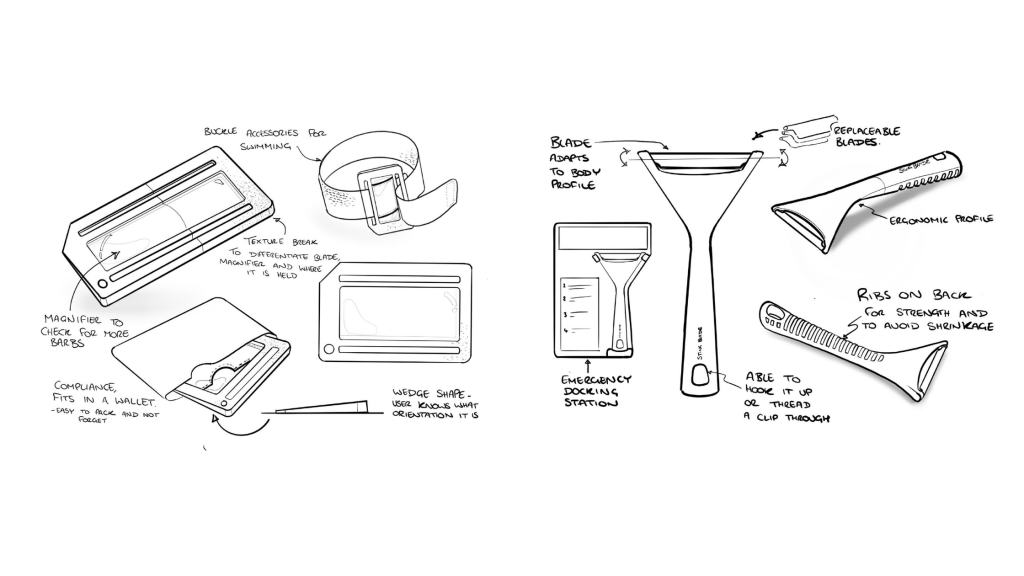
We created a range of initial ideas to address the problem and bring Mark’s vision to life in a way which was manufacturable, technically feasible and commercially desirable. These ranged from deployable handheld scrapers to devices with integrated tweezers. We only planned to select one single approach. However, Mark loved two of the ideas and hence both Stingblade Personal Sport and Stingblade Professional were born.
Were there any early concepts that didn’t make it through, and why?
Yes, two of the ideas were filtered out in the early stages. The reasons for not selecting these concepts mainly centered around the additional complexity of the designs, and the fact that we didn’t think the extra features justified the extra cost and risk.
What role did materials and ergonomics play in the final product?
They were critical. Personal Sport have to be comfortable and low-profile to wear, yet still easy to use in the water. Professional had to be easy for a second person to hold and use whilst keeping their hands away from the affected area.
Materials were critical for sustainability and performance. The plastic is made from recycled fishing nets (sourced in Cornwall). Stingblade Professional also has a titanium scraper edge, which is much more rugged and long lasting than the plastic edge of the Sport version.
What was the most challenging aspect of designing for a high-stress, emergency-use scenario like jellyfish stings?
Ensuring that the instructions for use were extremely clear, easy to remember and easy to follow.
Stingblade Professional is buoyant for use in water, how did that feature come about during development?
This actually came out of the design process, rather than influencing it from the very start. The first concept is unlikely to have been buoyant. It was something we added later when improving the look and feel of the product, because we also wanted a hollow handle to improve the appearance and for manufacturability – so it was a win-win.
How closely did Tone Design work with the Stingblade team throughout the process?
Very closely. The Stingblade team were involved in all key decisions during planned design and development progress update meetings. They reviewed and tested different versions of the design with prototypes throughout.
How did you translate Mark Dyer’s idea into a manufacturable product to treat jellyfish stings?
At Tone we have a clear step-by-step process to take ideas from concept through to manufacture, and guide clients through this if they haven’t developed a product before. People often underestimate the amount of work and thought involved in creating a product – however Mark was confident in his vision throughout and was willing to do whatever it took to get the best possible outcome.
Looking back, what are you most proud of in the final Stingblade products?
We always believe that the best products are the simplest. Many people think that simple is easy but it’s the opposite. Getting to a simple solution takes time, work, iteration, rework and extreme focus. Stingblade is a perfect example of an effective, simple solution to a big problem.
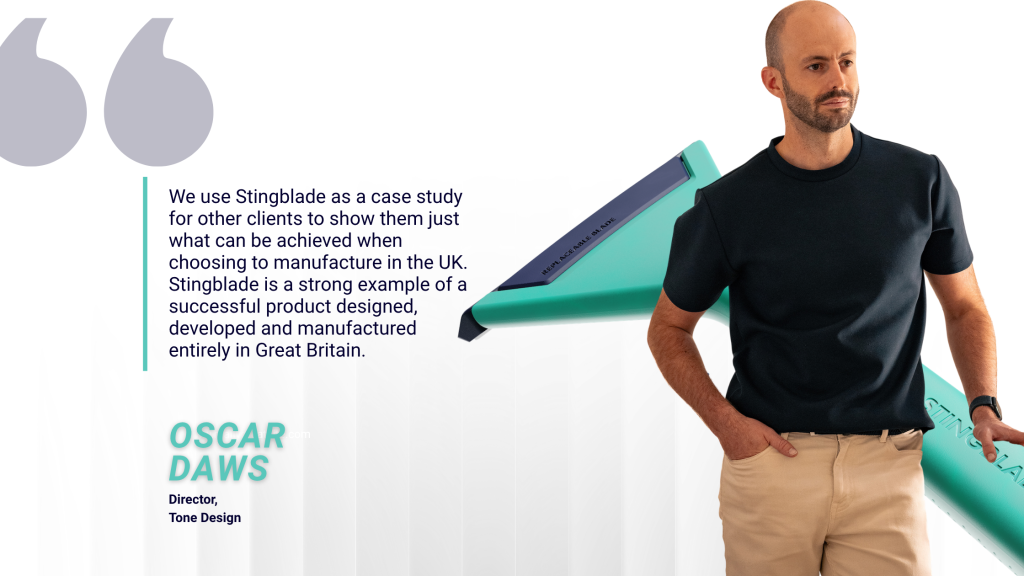
We use Stingblade as a case study for other clients to show them just what can be achieved when choosing to manufacture in the UK. Stingblade is a strong example of a successful product designed, developed and manufactured entirely in Great Britain.
Learn more about jellyfish stings, Stingblade, and explore the full range of products.
